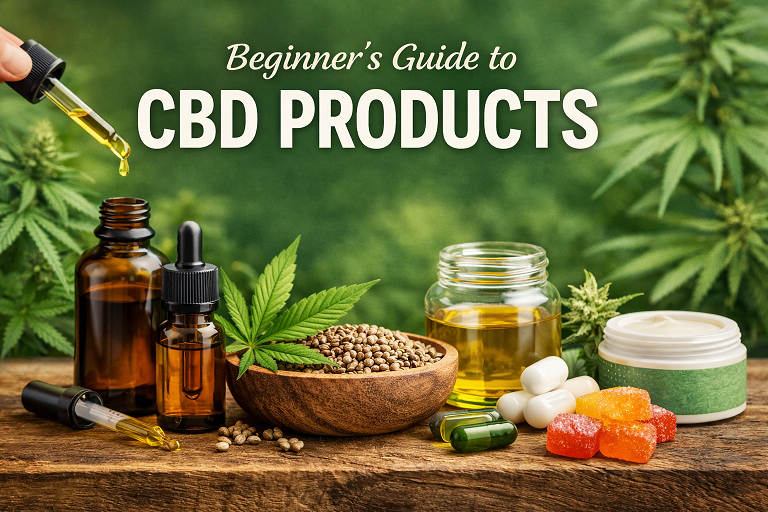
Beginner’s Guide to CBD Products
Walk into any pharmacy, health food shop, or even a gas station these days, and you’ll see CBD on the shelves. And if you’re new to all of this, it’s completely understandable to feel a little overwhelmed.
There’s a lot of noise around CBD. Some of it is genuine enthusiasm, some of it is exaggeration, and a fair bit of it is confusing terminology that makes something relatively simple sound far more complicated than it needs to be.
This guide is here to give you a solid foundation, what CBD actually is, where it comes from, the different forms it comes in, and what to pay attention to when you’re shopping. By the time you reach the end, you’ll feel a lot more confident navigating the CBD section on your own.
1. What Exactly Is CBD?
CBD stands for cannabidiol. It’s one of over 100 naturally occurring compounds found in the cannabis plant. These compounds are collectively called cannabinoids, and cannabidiol is simply one of the most researched and widely discussed among them.
The cannabis plant family includes both marijuana and hemp, two different varieties of the same species. Most CBD products you’ll find on store shelves today are derived from industrial hemp, which is a variety cultivated to contain very low levels of THC (the compound responsible for the psychoactive “high”) and comparatively higher concentrations of CBD.
Hemp has actually been farmed for thousands of years for fiber, seeds, and oil. It’s only in more recent years, following legislative changes like the 2018 Farm Bill in the United States, that hemp-derived CBD products became widely legalized and commercially available in many parts of the world.
It’s also worth clarifying that CBD is not a synthetic or lab-created substance, though it can be isolated in a laboratory setting. In its most natural form, it exists alongside dozens of other cannabinoids, terpenes, and plant compounds within the hemp plant.
2. CBD vs. THC — The Key Differences
This is the question almost everyone asks when they’re starting out. The short answer: CBD does not get you high. THC does.
Both CBD and THC are cannabinoids and they’re essentially chemical cousins, sharing a similar molecular structure. But despite that similarity, they interact with the body in very different ways. THC binds strongly to certain receptors in the brain in a way that produces intoxication. CBD doesn’t do this, which is why it’s described as non-intoxicating.
Here’s a quick side-by-side comparison:
| Feature | CBD | THC |
|---|---|---|
| Primary Source | Hemp | Marijuana |
| Psychoactive? | No | Yes |
| Legal in the US? | Federally legal if derived from hemp (under 0.3% THC) | Varies by state |
| Common Forms | Oils, gummies, capsules, topicals | Edibles, flower, concentrates |
| Drug Testing Risk | Low, but trace THC could still trigger a positive result | Will typically result in a positive test |
If you want to avoid THC entirely, there are product formats designed for exactly that purpose, which leads us directly into the spectrum discussion in Section 5.
3. How CBD Interacts With the Body
The endocannabinoid system (ECS) is a natural cell-signaling system in the body that helps regulate functions like mood, sleep, and appetite. It includes natural cannabinoids, receptors, and enzymes that keep everything balanced.
CBD interacts with this system, but unlike THC, it doesn’t bind directly to the main receptors. Instead, it works more indirectly, influencing how the system responds.
In simple terms, CBD works with a real biological system in the body, but research is still ongoing to fully understand how it functions.
4. Types of CBD Products
One of the things that surprises a lot of first-time buyers is just how many different product formats exist. Each one has its own characteristics in terms of how quickly it takes effect, how long effects may last, and what kind of routine it fits into.
CBD Oils and Tinctures
This is probably the most classic CBD product and the one most people picture when they think of CBD. It’s typically a concentrated liquid, CBD extract blended with a carrier oil such as hemp seed oil, MCT oil (from coconuts), or olive oil. You take it by placing drops under your tongue and holding them there for 30–60 seconds before swallowing.
Tinctures tend to act relatively quickly because some of the CBD is absorbed directly through the mucous membranes under the tongue. They’re also easy to adjust in terms of amount, since you can measure individual drops. You’ll find them in a wide range of strengths, usually measured in milligrams of CBD per bottle.
CBD Capsules and Softgels
For people who prefer something familiar and precise, capsules are a popular choice. Each capsule contains a pre-measured amount of CBD, so there’s no guesswork involved. They’re easy to incorporate into an existing supplement routine and are discreet to take anywhere.
The trade-off is that because capsules are digested, they take longer to move through your system than sublingual oils. Onset can take anywhere from 30 minutes to a couple of hours depending on your metabolism and what you’ve eaten.
CBD Gummies and Edibles
CBD gummies have become enormously popular, and it’s easy to see why they’re convenient, they taste good, and they feel approachable in a way that tinctures don’t for some people. Like capsules, they pass through the digestive system, so they take longer to kick in.
One thing to watch with gummies is the sugar content and added ingredients, particularly if you’re buying them frequently or have specific dietary considerations. Always check the ingredient list.
CBD Topicals (Creams, Balms, and Lotions)
Topicals are applied directly to the skin rather than ingested. Because they don’t enter the bloodstream in any meaningful way, they work very locally right where you apply them. This makes them a distinct category from the other product types.
You’ll find CBD topicals sold as creams, balms, salves, roll-ons, and even bath products. They typically contain other skin-friendly ingredients alongside CBD, things like shea butter, arnica, menthol, or essential oils.
CBD Vape Products
Vaping CBD involves inhaling vapor from a CBD e-liquid using a vaporizer or vape pen. Because the compounds enter the body through the lungs, the onset is typically the fastest of any delivery method.
That said, vaping comes with its own considerations around respiratory health, and it’s an area where product quality and ingredient transparency really matter. If this is a format you’re interested in, doing thorough research on the specific product and brand is especially important.
CBD Beverages
A newer and growing category, CBD beverages include things like CBD water, sparkling drinks, coffee, and tea. They’re convenient and approachable for everyday use. One thing to know is that CBD can be tricky to formulate into beverages as it doesn’t naturally dissolve in water, so the quality and bioavailability (how much your body actually absorbs) can vary quite a bit depending on how the product is made.
5. Full Spectrum, Broad Spectrum, and Isolate Explained
These three terms describe the composition of the CBD extract used in a product, and understanding them is genuinely useful when you’re trying to decide what to buy.
Full Spectrum CBD
Full spectrum CBD contains CBD along with other natural hemp compounds like cannabinoids, terpenes, and trace THC (up to 0.3% in the US).
It’s often chosen for the “entourage effect,” where these compounds may work better together. However, since it includes small amounts of THC, it may not be suitable if you want to avoid THC completely.
Broad Spectrum CBD
Broad spectrum is essentially full spectrum with the THC removed. It still contains a range of cannabinoids and terpenes from the hemp plant, so you get some of that multi-compound profile without the THC.
CBD Isolate
Isolate is exactly what it sounds like pure CBD, isolated from everything else. It typically comes as a white powder or crystal that can be added to oils, foods, or other products. Isolate contains no THC and none of the other plant compounds.
It’s the most processed of the three formats and, according to some research, may be less effective per milligram than full or broad spectrum options because the entourage effect is absent. However, it’s a solid choice if you want something with zero THC and a very clean ingredient profile.
A simple way to remember it:
- Full Spectrum = CBD + other cannabinoids + terpenes + trace THC
- Broad Spectrum = CBD + other cannabinoids + terpenes, NO THC
- Isolate = CBD only, nothing else
6. How to Read a CBD Label
Once you start browsing products, you’ll quickly notice that CBD labels can look wildly different from one another. Some are clear and informative; others are vague in ways that should give you pause. Here’s what to look for.
Total CBD vs. CBD Per Serving
Many products list the total CBD in the entire bottle or package, for example, “1000mg CBD.” But what you actually need to know is how much CBD is in each individual serving. A 1000mg tincture with 30 servings per bottle works out to roughly 33mg per serving, but a product with 20 servings would give you 50mg per serving from the same total amount. Always calculate it out.
The Ingredient List
Look for a carrier oil you recognize (MCT oil, hemp seed oil, olive oil) as the base for tinctures. Shorter ingredient lists with recognizable components are generally a better sign than long lists filled with fillers or artificial additives.
Hemp Extract vs. Hemp Seed Oil
This is a common source of confusion and, frankly, it’s caused by some intentionally misleading labeling in the market. Hemp seed oil is pressed from hemp seeds and contains essentially no CBD, it’s a nutritious cooking oil but it’s not the same thing as CBD oil. If you see “hemp seed oil” listed as the main ingredient with no mention of “hemp extract,” “CBD,” or “cannabidiol” anywhere on the label, the product likely contains little to no CBD.
Batch or Lot Number
Reputable CBD products should have a batch or lot number printed on the packaging. This is what allows products to be traced back to specific production runs and matched to lab test results.
QR Code or Website for Lab Results
This is one of the most important things to look for, and we’ll expand on it in the next section. Trustworthy brands make their third-party lab test results (called Certificates of Analysis, or COAs) easily accessible, either via a QR code on the packaging or through their website.
7. What Makes a Quality CBD Product
The CBD market is largely unregulated in many countries, which means quality varies enormously between brands. Learning to distinguish a well-made product from a poorly made one is one of the most valuable skills you can develop as a buyer.
Third-Party Lab Testing (COAs)
This is the single most important quality indicator. A Certificate of Analysis (COA) is a document from an independent, accredited laboratory that has tested the product and confirmed what’s actually in it.
A good COA should show:
- The actual CBD content (does it match what the label claims?)
- THC levels (is it within legal limits?)
- Results for heavy metals, pesticides, and residual solvents
- The date of testing and the batch number it corresponds to
Never buy CBD from a brand that can’t provide current, third-party COAs. No exceptions.
Source of the Hemp
Where and how the hemp was grown matters. Hemp is a bioaccumulator, it readily absorbs both nutrients and contaminants from the soil. Hemp grown in clean soil, under good agricultural practices, produces a cleaner raw material. Many quality brands source from US or European farms with transparent growing practices.
Extraction Method
The most widely used and well-regarded extraction method for CBD is CO2 extraction, which uses pressurized carbon dioxide to pull the cannabinoids and terpenes from the plant without leaving behind chemical residues. Ethanol extraction is another legitimate method. Cheaper extraction methods using hydrocarbon solvents can leave behind residues that should be tested for, which is yet another reason why COAs matter.
Brand Transparency
Quality brands are generally happy to tell you where their hemp comes from, how it’s processed, and what’s in their products. They’ll have accessible lab results, a responsive customer service team, and honest marketing that doesn’t make sweeping claims about what their products can do. If a brand seems evasive about sourcing or testing, that’s a meaningful red flag.
Price as a Signal
Good CBD isn’t cheap to produce. If you’re seeing a 1000mg CBD tincture for $10, that price point should raise questions about quality. That doesn’t mean you have to spend a fortune, but genuinely competitive pricing in the CBD market tends to reflect the cost of quality hemp, proper extraction, and rigorous testing.
8. Where to Start as a Beginner
If you’ve made it this far and you’re thinking about trying CBD for the first time, here are a few practical thoughts on getting started.
Start with a straightforward product: A mid-strength CBD tincture or a standard dose gummy from a reputable brand is a good way to start. You don’t need to start with the highest concentration available, quite the opposite.
Start low: If you’re new to CBD, begin with a lower amount than you think you need and see how you respond. Because CBD affects people differently based on factors like body weight, metabolism, and individual biochemistry, there’s no universal starting point.
Be consistent: Some people notice effects from CBD right away, others find that it takes a few weeks of regular use before they observe anything. Occasional use makes it harder to gauge how the product is working for you.
Buy from reputable brands: Use the quality markers discussed in Section 7. Look for brands that publish their COAs, have clear ingredient lists, and don’t make unrealistic claims about what their products will do.
Talk to your doctor: Especially if you’re taking any prescription medications, it’s worth having a conversation with your healthcare provider before adding CBD to your routine. CBD can interact with certain medications, including blood thinners, by affecting how your liver processes them.
9. Frequently Asked Questions
Will CBD make me feel high?
No. CBD is non-intoxicating. It does not produce the psychoactive effect associated with THC. Even full spectrum products that contain trace amounts of THC (up to 0.3%) do not contain enough to cause any intoxicating effect.
Will CBD show up on a drug test?
This depends on the type of test and the type of CBD product. Most standard drug tests screen for THC metabolites, not CBD. However, full spectrum products contain trace THC that could, in some circumstances, particularly with high doses or prolonged use accumulate enough to trigger a positive result. If you’re subject to regular drug testing, broad spectrum or isolate products are a safer choice. Even then, “THC-free” isn’t always a perfect guarantee, which is why verifying third-party lab results is important.
Is CBD legal?
In the United States, hemp-derived CBD products containing less than 0.3% THC are federally legal, though state laws vary. Internationally, the legal status of CBD varies significantly by country and it’s legal in many European countries but restricted or prohibited in others. Always check the rules specific to where you live.
How long does it take for CBD to work?
It depends on the delivery method. Sublingual oils typically produce effects within 15–45 minutes. Edibles and capsules can take 30 minutes to 2 hours because they’re digested. Topicals work locally and relatively quickly after application. Vaping produces the fastest onset, often within minutes.
Can you take too much CBD?
Research to date suggests CBD is well-tolerated even at relatively high doses, and there is no known lethal dose for humans. That said, taking very large amounts can cause side effects including drowsiness, dry mouth, reduced appetite, and diarrhea. More is not necessarily better with CBD, starting low and finding the amount that works for you is always the sensible approach.
Does CBD have any side effects?
Most people tolerate CBD well, but some do experience side effects, particularly at higher amounts. These can include drowsiness, dry mouth, lightheadedness, and digestive upset. CBD can also interact with certain medications, so if you take prescription drugs, speaking with your doctor first is genuinely important.
Is CBD the same as hemp oil?
Not necessarily. “Hemp oil” can refer either to hemp seed oil (pressed from the seeds, contains no CBD) or to CBD oil derived from the hemp plant. It’s an area where labels can be confusing or even misleading. Always look for “CBD,” “cannabidiol,” or “hemp extract” specifically on the label, and confirm it’s backed by a COA.
Can I give CBD to my pet?
There are CBD products specifically formulated for pets, and many pet owners use them. Pet physiology differs from human physiology in important ways. If you’re interested in CBD for a pet, speaking with a veterinarian first is the right move.
10. Final Thoughts
CBD is gaining attention for its potential and growing research, but it also comes with hype and low-quality products. As a beginner, take your time, ask questions, and choose transparent brands that provide clear ingredients, sourcing details, and lab reports (COA).
Start simple, understand the type of CBD, check what’s inside, and see how it works for you. It may feel overwhelming at first, but with the basics in place, making the right choice becomes much easier.
Disclaimer
This article is intended for educational and informational purposes only. It does not constitute medical advice, and no claims are made regarding the diagnosis, treatment, or prevention of any condition. Always consult a qualified healthcare professional before starting any new supplement, especially if you take prescription medications or have underlying health conditions.
We write rarely, but only the best content.
