
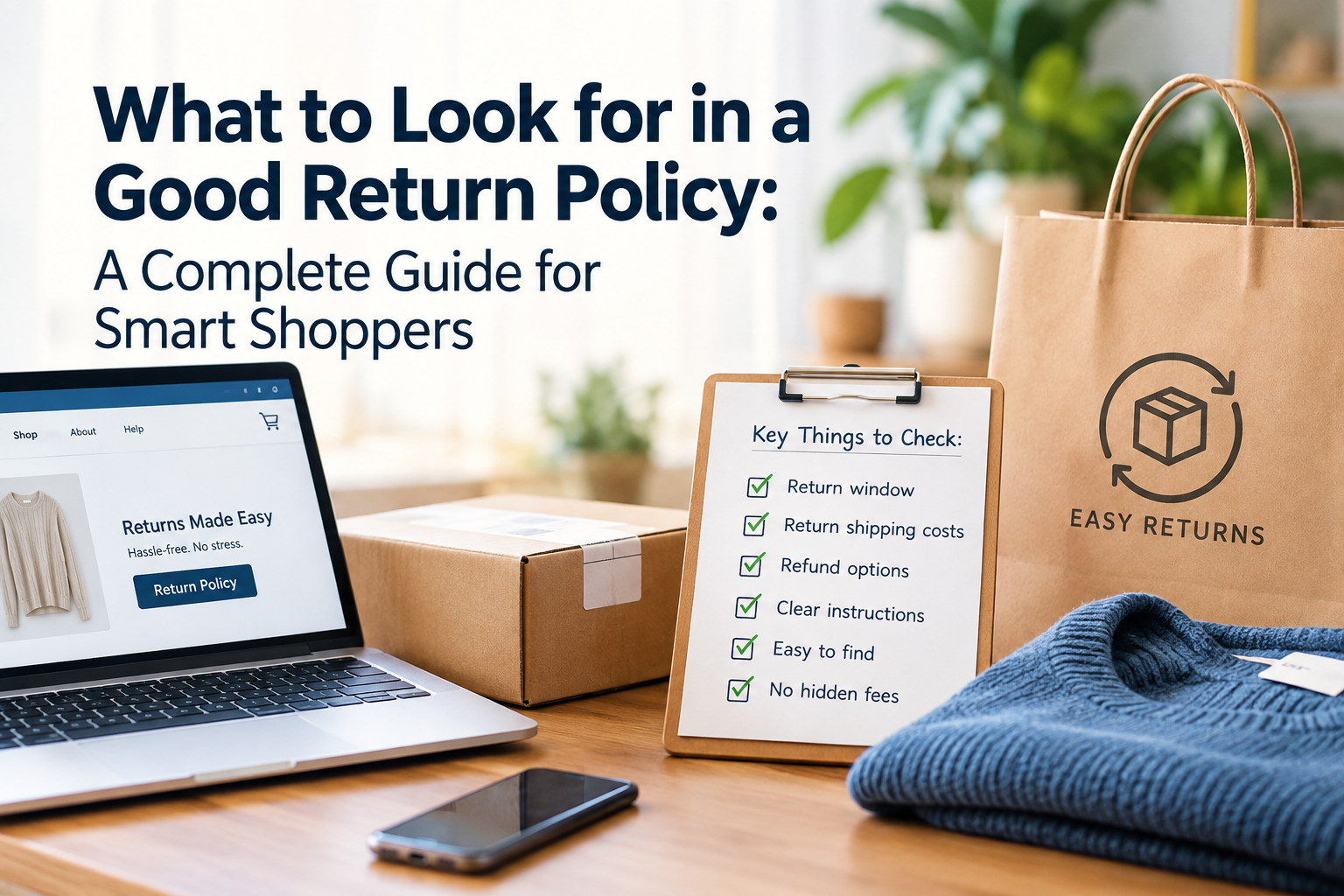
Return policies used to be an afterthought, a few lines of legal text buried in a footer link nobody clicked. That’s changed. Shoppers now treat return policies as a genuine deciding factor before they buy, and retailers have taken notice. Recent research, including Narvar’s 2025 State of Post‑Purchase Report, finds that around nine in ten online shoppers review a store’s return policy before completing a purchase, a sharp jump from just a few years ago. Retailers that display their return terms clearly on product pages have also reported higher checkout completion rates compared to those that hide the details away.
In this guide, we’ll walk through exactly what separates a genuinely good return policy from a mediocre or misleading one, the red flags worth watching for, and how return policies are shifting in 2026 as retailers try to balance customer trust with the rising cost of processing returns. Whether you’re a shopper trying to buy with confidence or a business owner trying to write a policy that builds loyalty instead of losing customers, there’s something here for you.
Why Return Policies Matter More Than Shoppers (and Retailers) Realize
Returns are no longer a minor operational detail. They’ve become one of the biggest line items in ecommerce, and the numbers behind them are hard to ignore.
- An estimated 19.3% of U.S. online sales were expected to be returned in 2025, according to the National Retail Federation (NRF) and Happy Returns’ 2025 Retail Returns Landscape report.
- U.S. retail returns were projected to reach an estimated $849.9 billion in 2025, highlighting the significant scale and cost of returns for retailers.
- Apparel remains the most returned category, with return rates commonly landing between 20 and 40 percent, largely due to sizing and fit issues.
- A notable share of shoppers—around nine in ten in Narvar’s 2025 State of Post‑Purchase Report—say they review a store’s return policy before completing a purchase, underscoring how central returns are to purchase confidence.
- Free and low-friction returns continue to influence buying decisions, with NRF research showing that a strong majority of consumers consider free returns an important factor when shopping online.
What this tells us is simple. A return policy isn’t just a safety net for shoppers, it’s a trust signal. When it’s clear, fair, and easy to find, people feel more comfortable clicking “buy now.” When it’s vague, restrictive, or hidden, hesitation creeps in, and carts get abandoned.
The Core Elements of a Good Return Policy
Not all return policies are created equal. Some are written to genuinely protect the customer, while others are written to protect the business at the customer’s expense. Here’s what actually matters.
1. A Clear, Reasonable Return Window
The first thing to look for is how much time you actually have to decide whether to keep or return an item. Industry norms typically range from 14 to 90 days, with 30 days being a common baseline. A good policy states this window in plain language, and ideally tells you whether the clock starts from the order date, the delivery date, or the date the item ships.
Watch for policies that shrink drastically around holidays or that quietly reduce the window for sale items. A trustworthy retailer will spell out any exceptions upfront rather than letting you discover them after the fact.
2. Transparent Return Shipping Costs
Who pays to send the item back matters more than people expect. Some retailers offer completely free returns, some charge a flat restocking or shipping fee, and others deduct the cost of return shipping from your refund. Recent data from Loop’s 2026 retention benchmarks show that about 65.2 percent of merchants now charge a fee on at least some return outcomes, with an average fee around $9.04, a shift from the “free returns for everyone” era of the early 2020s.
A good policy is upfront about this cost structure before you buy, not after you’ve already committed. Research from the International Council of Shopping Centers (ICSC) has found that a majority of shoppers become less likely to purchase when they learn a retailer charges return fees, which is exactly why transparency here builds more trust than surprise fees ever could.
3. Multiple Refund and Resolution Options
A flexible return policy typically gives you more than one path forward, such as:
- A full refund to your original payment method
- Store credit, sometimes with a bonus incentive to encourage it
- A direct exchange for a different size or color
- In some cases, a “returnless refund,” where you keep the item and still get your money back, a growing practice for low-value goods where return shipping costs more than the product itself
Retailers who only offer store credit, with no option for a cash refund, are prioritizing their own cash flow over your convenience. That’s worth noticing before you buy.
4. A Straightforward, Low-Friction Process
A good return policy doesn’t just say returns are accepted, it explains how to actually do one. Look for:
- A self-service return portal where you can start a return without emailing customer support
- Prepaid, printable shipping labels
- Clear instructions on packaging requirements
- An estimated timeline for when you’ll see your refund, commonly within about three to ten business days after the item is received, plus any additional time your bank or card issuer needs to post the credit
If a policy requires you to call a phone number during limited business hours just to start a return, that’s a meaningful red flag for how much friction you’ll deal with.
5. Clearly Stated Exceptions and Restrictions
Almost every retailer has some categories that can’t be returned, such as personal care items, undergarments, custom or personalized goods, digital products, or perishable items. A good policy lists these exceptions clearly in one place rather than scattering them across the site or burying them in fine print.
It’s also worth checking whether items need to be unworn, unwashed, or have tags attached, and whether original packaging is required. These conditions are normal, but they should be easy to find and understand before you make a purchase, not discovered when your return gets rejected.
6. Easy Accessibility and Visibility
A genuinely good return policy isn’t hidden. It should be:
- Linked directly from product pages, not just the footer
- Written in plain, everyday language rather than dense legal jargon
- Easy to find through a simple site search
- Consistent across the website, checkout page, and order confirmation emails
Retailers that make an effort to display return terms prominently tend to see better conversion and fewer post-purchase complaints, which is exactly why this has become a growing best practice in ecommerce design.
7. Responsive Customer Support
Even the best-written policy occasionally needs a human touch. Look for retailers who offer live chat, email, or phone support for return questions, and check whether they publish expected response times. Many brands have also started using AI-assisted chat tools to help customers check order status or start a return instantly, which can meaningfully speed up an otherwise frustrating process.
Red Flags That Signal a Weak or Misleading Return Policy
Sometimes what a policy doesn’t say is more telling than what it does. Keep an eye out for these warning signs.
- Vague or missing timeframes: If a policy simply says “returns accepted” without specifying a window, that ambiguity usually favors the retailer, not you.
- Restocking fees that aren’t disclosed until checkout: Hidden fees that only appear late in the buying process are a common source of customer frustration and complaints.
- “Final sale” language applied too broadly: Some retailers quietly mark most of their catalog as final sale, which effectively removes your ability to return almost anything.
- No confirmation or tracking for return shipments: If there’s no way to confirm your returned item was received, you’re relying entirely on trust.
- Refunds that take unusually long: Typical processing runs about three to ten business days after the item is received, plus any additional time your bank or card issuer needs to post the credit. Anything significantly longer, especially without explanation, is worth questioning.
- Store credit only, no refund option: This can trap your money within a single brand, particularly frustrating if you’re unhappy with the product or service overall.
Good vs Weak Return Policy: A Quick Comparison
| Feature | What a Good Policy Looks Like | What a Weak Policy Looks Like |
|---|---|---|
| Return window | Clearly stated, typically 30 days or more | Vague, unusually short, or not disclosed upfront |
| Return shipping cost | Disclosed before purchase, free or low flat fee | Hidden until after you’ve bought, high or unclear cost |
| Refund options | Cash refund, exchange, and credit all available | Store credit only, with no refund option |
| Process | Self-service portal with prepaid label | Requires phone call or lengthy email chain |
| Visibility | Linked on product pages and at checkout | Buried in footer or hard to find |
| Refund timeline | 1 to 7 business days after item is received | Weeks with no clear timeline given |
How Return Policies Are Evolving in 2026
Return policies aren’t static, and the last couple of years have brought some notable shifts worth understanding as a shopper.
Return Fees Are Becoming More Common, Not Less
The “free returns, no questions asked” model that defined much of the 2010s and early 2020s is quietly giving way to more selective policies. As returns have climbed toward one in five online orders in many categories, retailers have had to weigh the cost of processing each one, often estimated somewhere between $10 and $65 per item depending on category, shipping, labor, and restocking. As a result, more merchants now charge a fee on certain return types while still keeping exchanges free, a strategy designed to protect margin without completely alienating customers.
Returnless Refunds Are Growing
For lower-cost items, some retailers have found it’s simply cheaper to let customers keep the product and issue a refund anyway, rather than pay to ship, inspect, and restock it. This approach, often called a “returnless refund,” has become more common in categories like inexpensive home goods, accessories, and certain grocery or consumables purchases.
AI Is Reshaping the Returns Experience
A growing share of retailers now use AI‑powered tools to manage returns, from automatically routing customer inquiries to predicting which returns are likely fraudulent. Recent NRF and Happy Returns data indicate that about 85 percent of merchants are using AI or machine learning in their returns processes most commonly for fraud detection and workflow automation, though effectiveness varies by retailer.
For shoppers, this can mean faster answers and quicker refunds in some cases, but it also means fraud detection systems are more sophisticated, so unusually frequent returns on your account could trigger extra scrutiny or restrictions over time.
Return Fraud Is a Growing Concern for Retailers
Return fraud, things like wardrobing, empty‑box returns, or item switching is estimated at roughly 9 percent of all returns in 2025 by NRF, while broader industry measures that include abuse put the figure closer to 14 to 15 percent. That risk is a major reason some retailers have tightened policies or introduced return limits for repeat offenders.
Sustainability Is Entering the Conversation
Reverse logistics, the process of getting returned items back to a warehouse, has a real environmental footprint. Some brands have begun experimenting with local drop-off points, consolidated return shipping, or donation-based alternatives for low-value returns instead of shipping them back at all. It’s a trend still in its early stages, but one that’s likely to grow as both consumers and regulators pay closer attention to packaging waste and shipping emissions.
Tips for Shoppers: How to Buy with Confidence
You don’t need to memorize every retailer’s fine print, but a few habits can save you real headaches later.
- Read the policy before you buy, not after. It only takes a minute and can save you from an unpleasant surprise.
- Screenshot or save confirmation emails. These often contain the return window and terms that applied at the time of your purchase.
- Check for a specific policy on sale or clearance items. These are frequently treated differently, sometimes as final sale.
- Keep original packaging when possible, at least until you’re sure you’re keeping the item.
- Note the difference between “return” and “exchange” policies. Some brands are more generous with exchanges than refunds.
- Use tracked shipping when sending a return, so you have proof of delivery if a dispute comes up.
Tips for Businesses: Writing a Return Policy That Builds Loyalty
If you’re on the retail side, your return policy is quietly doing a lot of marketing work, whether you’ve thought of it that way or not. A few principles tend to separate the policies that build trust from the ones that generate complaints.
- Lead with clarity, not legalese. Plain language builds more trust than technically accurate but confusing wording.
- Put the policy where people will actually see it. Product pages and checkout pages convert better than footer-only placement.
- Segment your policy by category when it makes sense. A blanket policy rarely fits electronics, apparel, and perishables equally well.
- Be honest about fees before checkout, not after. Surprise costs are one of the fastest ways to generate negative reviews.
- Offer more than one resolution path. Combining refunds, exchanges, and credit options tends to satisfy a wider range of customer needs.
- Track return reasons, not just return rates. A high return rate caused by sizing issues points to a different fix than one caused by damaged shipments.
Frequently Asked Questions
How long should a return window typically be?
Most retailers offer somewhere between 14 and 90 days, with 30 days being one of the most common standards in ecommerce. Some retailers extend this window during major holiday shopping periods to accommodate gift purchases.
Do I have to pay for return shipping?
It depends on the retailer. Some offer completely free returns, while others charge a flat fee or deduct return shipping costs from your refund. A growing number of merchants now charge fees on at least some return types, so it’s worth checking the specific policy before you buy.
What is a “returnless refund”?
A returnless refund happens when a retailer refunds your money but tells you to keep the item, usually because the cost of shipping, inspecting, and restocking the product would exceed its value. This is becoming more common for lower-priced goods.
Why do some stores only offer store credit instead of a refund?
Offering store credit instead of a cash refund helps retailers retain revenue within their business rather than losing the sale entirely. It’s a common practice, but it’s worth checking whether a retailer also offers a true refund option if that matters to you.
How long does it usually take to get a refund?
Once a returned item is received and processed, most refunds are issued within about three to ten business days. It may take a few additional days for the refund to appear on your bank or card statement, depending on your financial institution.
What items are commonly excluded from return policies?
Common exclusions include personal care and hygiene items, underwear and swimwear, custom or personalized products, digital downloads, gift cards, and perishable goods. Final sale or clearance items are also frequently excluded.
Can a retailer refuse my return even if it’s within the stated window?
Yes, if the item doesn’t meet the stated conditions, such as being worn, missing tags, or lacking original packaging, a retailer may reject the return even within the return window. This is why it’s helpful to read the specific conditions listed in the policy, not just the timeframe.
Are return policies legally required to disclose certain information?
Requirements vary by location and are set by local consumer protection laws, so retailers may have different disclosure obligations depending on where they operate and where the customer is located. If you have questions about your specific rights, checking your local consumer protection agency’s guidance is generally the most reliable approach.
Final Thoughts
A good return policy isn’t just about getting your money back if something goes wrong. It’s a reflection of how much a business respects your time, your trust, and your experience as a customer. The clearest policies tend to share the same traits: a reasonable timeframe, honest pricing, multiple resolution options, and language you can actually understand without a law degree.
As return fees, AI-driven support, and returnless refunds continue reshaping ecommerce in 2026, the fundamentals haven’t really changed. Whether you’re comparing two retailers before checkout or rewriting your own store’s policy, the goal is the same: make the process fair, make it clear, and make it easy to find. That’s what separates a return policy people trust from one that quietly erodes it.
