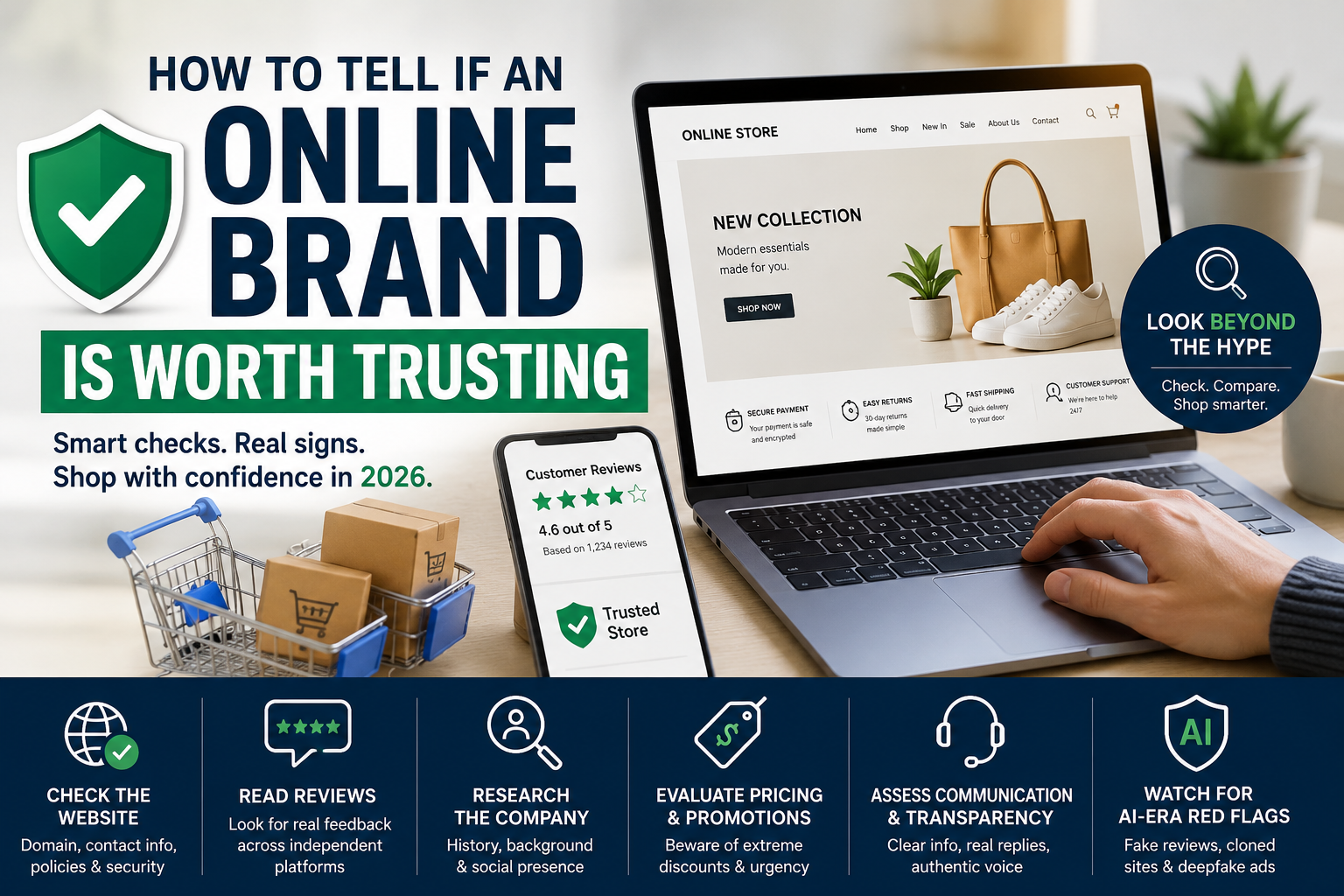
The good news is that trustworthy brands still leave a trail of evidence, and so do the ones that aren’t. You just need to know where to look. This guide walks through the practical, repeatable checks you can run on any online store or brand before you hand over your card details, along with the newer red flags that have shown up as shopping has become more automated.
Why Trust Is Harder to Judge Online in 2026
A few years ago, a sloppy website was usually a giveaway that a store wasn’t legitimate. That signal is far less reliable now. Website builders and AI design tools make it easy for anyone, including scammers, to spin up a polished storefront in an afternoon. Some fraudulent sites are visually convincing enough that even experienced shoppers can be fooled without digging a little deeper.
At the same time, consumer research shows people are growing more cautious rather than less. Recent industry surveys on shopping behavior found that about 98% of shoppers read reviews before buying from an unfamiliar brand, and many say they specifically look for signs that reviews and star ratings are real rather than manufactured. A pattern is emerging: shoppers aren’t giving up on online brands, they’re just getting more particular about the evidence they’ll accept.
That shift is worth understanding before you evaluate any brand, because it explains why the checks below matter more than ever, and why a shiny homepage alone isn’t proof of anything.
Start With the Website Itself
Before you even think about reviews or social proof, the site itself will tell you a lot if you know what to look for.
Check the domain and URL details
Look closely at the web address, not just the logo at the top of the page. Scammers frequently register domains that look almost identical to a well known brand, swapping a letter, adding a hyphen, or using a different domain extension. If you’re not sure whether a site is the real one, open a new tab and search for the brand name directly rather than clicking a link from an email or ad.
- Confirm the URL matches the brand’s official domain, not a lookalike spelling
- Look for the padlock icon and “https” at the start of the address, which signals an encrypted connection
- Be wary of unusual domain extensions for a brand that claims to be a major US or UK retailer
Look for real, findable contact information
A legitimate business generally isn’t shy about how to reach it. Check for a physical address, a working phone number, and an email address that uses the company’s own domain rather than a generic address. If the only way to contact a store is through a vague web form with no other detail, treat that as a caution flag rather than a dealbreaker on its own.
Read the policies, not just skim past them
Return policies, shipping timelines, and a privacy policy might not be exciting reading, but their presence and clarity say a lot. Brands that are confident in what they sell tend to spell out exactly how returns, refunds, and data handling work. Vague, missing, or copy-pasted policy pages are a common shortcut taken by low-effort or short-lived storefronts.
Confirm the checkout is genuinely secure
Beyond the padlock icon, look for recognizable payment options at checkout, such as major credit cards or established services like PayPal. If a site insists on payment methods that are hard to trace or reverse, like wire transfers, cryptocurrency, or gift cards, for an ordinary retail purchase, that’s one of the clearer warning signs you’ll come across.
Investigate Reviews Like a Skeptic, Not a Cynic
Reviews remain one of the most powerful trust signals online, but they’re also the easiest thing for a brand to fake. The trick is learning to read them the way experienced shoppers do, rather than just glancing at the star average.
A flawless review profile is often a red flag, not reassurance
It’s tempting to assume a brand with nothing but five star reviews must be great. In practice, shoppers have become more suspicious of that pattern, not less; nearly half of consumers say reviews that read like AI make them distrust a brand, and many report more trust when they see a believable mix of ratings. Consumer research on online reviews has found that a majority of people trust a brand more when its reviews include some visible negative feedback, especially when the company responded to it constructively. An unnaturally perfect review page, with no complaints at all, often suggests reviews are being filtered, purchased, or generated rather than collected honestly.
Pay close attention to how a brand handles complaints
How a company responds to a bad review can tell you more than the review itself. Survey data on consumer trust consistently shows that shoppers weigh a brand’s response to negative feedback almost as heavily as the rating itself, watching for a genuine resolution rather than a copy-pasted apology. A brand that engages honestly with criticism is signaling something real about how it treats customers after the sale, not just before it.
Cross check reviews across more than one platform
Don’t rely solely on the reviews displayed on the brand’s own website, since those can be curated or filtered by the company itself. Check independent sources too, such as:
- Google Business reviews for the company
- Trustpilot or similar independent review platforms
- The Better Business Bureau, especially for US based companies
- Reddit or other forums, where people often discuss brands with no incentive to sugarcoat their experience
If a brand looks great on its own site but has a thin or troubling presence everywhere else, that gap is worth paying attention to.
Major platforms are also actively filtering suspected AI reviews; for example, Yelp reports removing hundreds of thousands of suspected AI-generated reviews, and Amazon says it blocked hundreds of millions of suspected fake reviews in 2025 alone.
Know that reviews are now regulated, not just a marketing tool
It’s worth knowing that fake and incentivized reviews aren’t just a trust problem anymore, they’re a legal one for the businesses that use them. In the US, the FTC’s Trade Regulation Rule on the Use of Consumer Reviews and Testimonials took effect on October 21, 2024 and prohibits companies from buying, faking, or suppressing reviews, with civil penalties of up to $51,744 per violation in 2026. Regulators have since begun sending formal warnings and taking enforcement actions against companies suspected of violating the rule. This doesn’t mean every glowing review is fabricated, but it does mean legitimate, established brands increasingly have a real incentive to keep their review practices clean, which is one more reason a suspiciously spotless review page deserves a second look.
Research the Company Behind the Brand
A brand’s marketing tells you what it wants you to believe. A quick background check tells you what’s actually out there.
Search the brand name alongside words like “review” or “complaint”
This simple step catches a surprising number of problems. If a brand has a pattern of unresolved complaints, chargebacks, or accusations of not shipping orders, this kind of search tends to surface it fairly quickly, especially on forums or social media where people vent about bad experiences.
Check how long the business has actually existed
Domain lookup tools can show you when a website’s domain was registered. A brand claiming to be an established company but running on a domain that’s only a few months old is worth extra scrutiny. This isn’t proof of anything bad on its own, since legitimate new businesses exist too, but it’s a useful data point to weigh alongside everything else.
Look at social media, but look past the follower count
Follower counts can be purchased, so they’re not a reliable trust signal by themselves. What matters more is engagement quality: are real people commenting, asking questions, and getting answered by the brand? Does the account post consistently over time, or does it look like it was set up recently with a burst of activity? A brand that interacts genuinely with its audience is usually a better sign than one with big numbers and silence in the comments.
Evaluate Pricing and Promotions With a Critical Eye
Treat extreme discounts as a signal to slow down
Everyone loves a good deal, and legitimate sales absolutely happen. But when a product is priced dramatically below what it normally sells for, sometimes 70 to 90 percent off, that’s one of the most consistent warning signs associated with counterfeit goods and scam storefronts. It’s not that discounts are inherently suspicious, it’s the size and framing of the discount that matters, especially when it’s paired with countdown timers or claims of extremely limited stock.
Compare the price across a few other retailers
Before buying from an unfamiliar brand, it’s worth taking two minutes to check what the same or similar product typically costs elsewhere. If one site’s price looks wildly out of step with everyone else’s, that gap deserves an explanation, not just excitement about the savings.
Watch for manufactured urgency
Countdown clocks, “only 2 left in stock” banners, and pop-ups claiming other shoppers just bought the item are common ecommerce tactics, and not every use of them is dishonest. But when urgency messaging is combined with vague product details, unusually low prices, and thin contact information, it starts to look less like smart marketing and more like pressure designed to stop you from checking the brand out properly.
Assess the Brand’s Communication and Transparency
Clear, specific product information
Genuine brands tend to describe their products with real specificity, including materials, sizing, and what’s actually included. Vague descriptions, stock photos that don’t quite match what’s described, or product copy riddled with awkward phrasing and small errors are common on lower effort or fraudulent sites.
Real customer service, not just a chatbot loop
Try reaching out with a simple pre-purchase question before you buy, especially for a bigger purchase. A brand that responds like an actual person, even if it takes a day, is a good sign. A brand that only offers a chatbot stuck in a loop, or never responds at all, tells you something about what to expect if something goes wrong with your order.
An authentic voice across the brand’s content
Brand writing has a personality, even in small ways: a familiar way of describing products, a consistent tone in emails, a sense that a real team is behind the words. Content that reads as generic, oddly repetitive, or strangely impersonal across every page can sometimes point to a brand cutting corners on the basics, which is worth factoring in even if it isn’t proof of anything by itself.
Watch Out for AI-Era Red Flags
The tools available to build convincing fake storefronts and manufacture social proof have gotten a lot more sophisticated, so it’s worth knowing what to look for specifically.
AI-generated reviews and testimonials
Reviews that read as unusually polished, oddly generic, or that repeat the same specific phrases across supposedly different customers can be a sign of AI generated or purchased content rather than genuine feedback. Around 30% of all online reviews are estimated to be fake or inauthentic, and nearly half of consumers say reviews that read like AI make them distrust a brand. A believable review usually has small, specific, sometimes messy details, like a mention of exactly how something fit or how long shipping actually took, rather than sweeping praise.
Cloned or copycat websites
Some scam sites don’t try to look original at all. They copy an established brand’s layout, photos, and even its name with a tiny variation. If a deal seems to be coming from a big, recognizable brand but the URL, contact details, or checkout process feel slightly off, it’s worth navigating to the brand’s official site directly rather than trusting the link you were given.
AI generated ads featuring real looking people
Video and image ads that appear to feature a celebrity, doctor, or influencer endorsing a product should be treated with extra caution, particularly if the endorsement showed up through a random social media ad rather than the person’s own verified account. Manipulated or synthetic endorsement videos have become common enough that a surprising claim from a recognizable face is worth verifying independently before you trust it.
A Quick Trust Checklist
Here’s a condensed version you can run through in a few minutes before buying from a brand you don’t already know.
| What to check | Good sign | Warning sign |
|---|---|---|
| Website address | Matches the official brand domain, uses https | Slightly misspelled domain, no padlock icon |
| Contact information | Real address, phone number, and email on the brand’s domain | Only a vague contact form, no verifiable address |
| Reviews | A believable mix of positive and negative feedback, spread across multiple platforms | Only perfect five star reviews, reviews only visible on the brand’s own site |
| Pricing | Roughly in line with other retailers | Extreme discounts, especially with countdown timers |
| Policies | Clear, specific return, shipping, and privacy policies | Missing, vague, or copy-pasted policy pages |
| Company history | Established presence, findable business registration | Very new domain claiming to be a long-standing brand |
| Customer service | A real response to a pre-purchase question | No response, or a chatbot stuck in a loop |
When It’s Best to Just Walk Away
Not every red flag is a dealbreaker on its own, and plenty of legitimate small brands will have a few imperfections, like a slow email response or a website that isn’t fully polished. What matters more is the pattern. If you find yourself explaining away several warning signs at once, that’s usually the moment to step back rather than push forward.
Some situations are worth treating as a hard stop regardless of how good the deal looks, including:
- A checkout page that only accepts untraceable payment methods for an ordinary purchase
- A brand name you can’t find any independent mention of anywhere outside its own site
- Pressure tactics combined with a refusal to answer basic questions before you buy
- A site that closely mimics a well known brand but has a slightly different domain
Trusting your instincts still matters here. If something feels off after you’ve gone through these checks, it’s usually worth listening to that instinct rather than talking yourself out of it because the price looked good.
Frequently Asked Questions
How can I tell if an online store is legitimate before I buy?
Check the website’s URL for a proper domain and https connection, look for real and specific contact information, read independent reviews on more than one platform, and compare pricing against other retailers. No single check is foolproof, but a brand that passes most of these is generally on solid footing.
Are five star reviews always a good sign?
Not necessarily. Research on consumer trust suggests many shoppers are actually more wary of a review page with nothing but perfect ratings, since it can suggest reviews are being filtered or manufactured. A believable spread of feedback, along with thoughtful responses to any complaints, tends to be a more reliable signal.
What’s the safest way to pay when trying a new online brand?
Generally, credit cards or well established payment services offer stronger buyer protection and easier dispute resolution than wire transfers, cryptocurrency payments, or gift cards, which are difficult to reverse if something goes wrong. This is general guidance rather than financial advice, so consider your own circumstances and your card issuer’s specific policies.
How do I know if reviews were written or generated by AI?
Look for oddly generic praise, repeated phrasing across supposedly different reviewers, or a lack of specific, small details that a real customer would typically mention. Cross checking reviews across multiple independent platforms, rather than relying only on the ones shown on the brand’s own site, also helps you get a fuller picture.
Is it safe to buy from a brand that’s brand new?
Not automatically unsafe, but it does call for extra caution. New brands can be entirely legitimate, so weigh a young domain age alongside other signals like transparent contact information, clear policies, secure checkout, and any independent reviews or mentions you can find, rather than treating it as a dealbreaker by itself.
What should I do if I think I’ve been scammed by an online brand?
Contact your bank or card issuer promptly to ask about disputing the charge, keep records of the order and any communication with the seller, and consider reporting the business to your country’s relevant consumer protection agency, such as the FTC in the United States, so others can be warned.
Final Thoughts
There’s no single test that proves an online brand is trustworthy, and that’s honestly the point. The brands worth buying from tend to hold up well across several different checks at once: a real website, reviews that feel human, pricing that makes sense, and a team that actually responds when you reach out. The ones that don’t hold up usually reveal themselves once you look past the surface, even if that surface looks polished.
Building this habit doesn’t need to slow down your shopping much. A few minutes of checking before you buy from an unfamiliar brand can save you a genuine headache later, and over time, spotting the difference between a real brand and a well disguised one becomes second nature.
