
What Makes Premium Apparel Truly Worth the Price?
Let me be honest with you. I’ve stood in a changing room holding a plain navy sweater with a $380 price tag and genuinely laughed out loud. Then I put it on. The weight of it, the way it sat on my shoulders, the softness against my neck, something was amazingly different. I didn’t buy it that day. But I thought about it for three weeks, eventually went back, and it’s now the most-worn thing in my wardrobe, five years later and looking better than the day I got it. That experience is what this guide is really about.
Why this question matters more than ever
We live in a bizarre moment for clothing. You can buy a full outfit for less than a dinner for two, shipped to your door overnight. And yet a single jacket from a heritage brand might cost as much as a month’s rent. The gap between the cheapest and most expensive clothing has never been wider and the marketing on both ends has never been louder.
Fast fashion brands have gotten very good at looking premium on a hanger. Structured lapels, nice buttons, clever photography. Premium brands, meanwhile, sometimes lean so hard into mystique and heritage that they forget to explain why anything they make is worth the premium. The result? Most shoppers are genuinely confused about what they’re paying for and that confusion is costing them money in both directions.
This guide is an attempt to cut through all of that. Not to tell you that expensive is always better, it isn’t. But to give you the actual knowledge to tell the difference, make smarter choices, and build a wardrobe that serves you for years rather than seasons.
The Fabric truth, Materials you can actually Feel
The single biggest driver of quality in any garment is the raw material it starts with. This isn’t marketing poetry, it’s manufacturing reality. You cannot make a great garment from mediocre fiber, no matter how skilled the tailor.
Cotton: not all white fibers are equal
Standard cotton has a staple length (individual fiber length) of around 25mm. Egyptian cotton runs 35–45mm Pima (also called Supima when grown in the US) sits in a similar range. Longer fibers mean fewer exposed fiber ends per square inch, which means less pilling, a smoother hand feel, and a fabric that gets softer, not rougher with washing. A Sea Island cotton shirt from a quality maker feels almost silk-like against the skin. The same design in commodity cotton will feel noticeably coarser within a year of regular washing.
Wool: the micron number that matters
Wool fiber diameter is measured in microns (thousandths of a millimeter). Human skin registers fiber ends as “scratchy” once they exceed about 18.5–19 microns. This is why your grandmother’s old sweater felt like wearing a wire brush. Quality merino wool particularly superfine grades at 15–17 microns is genuinely imperceptible against bare skin. Cashmere averages 14–16 microns and comes from the undercoat of specific goats raised in Mongolia and Inner Mongolia. The world’s finest wools (Vicuña, at 12 microns) are extraordinarily rare and expensive for a real reason – the fiber count simply cannot scale.
Linen, silk, and the natural fiber premium
Linen improves with age in a way no synthetic can replicate, the fibers soften and develop a characteristic drape over years of wear and washing. Silk from long-reeled cocoons is noticeably more lustrous and stronger than short-reeled alternatives, the difference shows up in how the fabric moves. These natural fibers breathe, thermoregulate, and age in ways that polyester and viscose simply don’t. They’re also more demanding to produce, which is why they cost more.
Construction: the invisible hours in every seam
Even with exceptional fabric, a badly made garment falls apart. Construction is where the labor hours, and therefore much of the cost actually live. It’s also where the differences are most invisible to the untrained eye, which is exactly why brands can get away with cutting corners here.
The suit jacket as a case study
A mass-market suit jacket is essentially glued together. A fused interfacing, a bonded material is heat-pressed to the outer fabric to give it shape and structure. It’s fast, cheap, and consistent. The problem is that after dry cleaning or even just sustained wear, the glue begins to separate. You’ve seen it that slight bubbling around the chest, the lapel that doesn’t quite roll the same way anymore. Once it starts, it can’t be reversed.
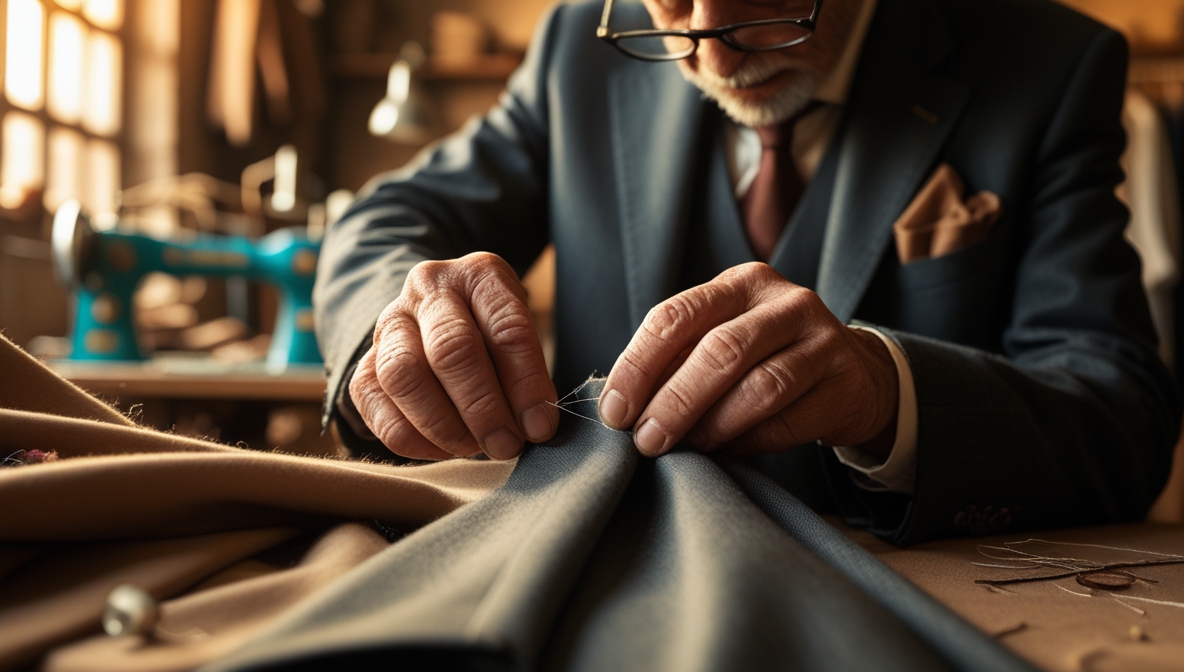
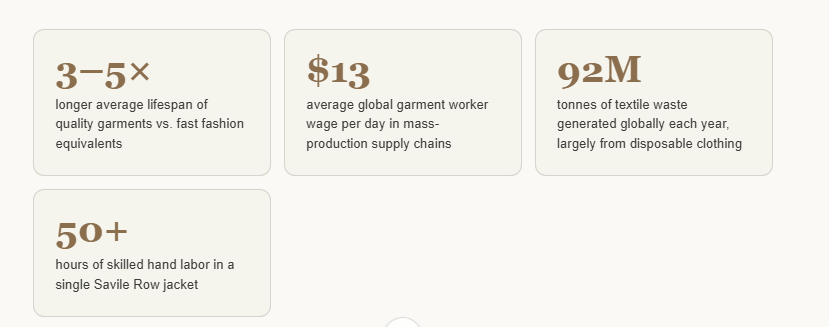
A properly made jacket uses a floating canvas, a layer of horsehair and wool canvas that is hand-stitched to the outer fabric with thousands of tiny stitches that allow it to move independently. Over time and with wear, this canvas actually conforms to the shape of your individual body. The jacket molds to you. It improves. That hand-stitched canvas represents roughly 30–40 hours of a skilled tailor’s time, which is where a large portion of the price lives.
Seams: the engineering inside every garment
- Flat-felled seams (the seam folded back and stitched down on both sides) create a nearly indestructible joint, this is why well-made jeans and workwear last decades. Budget garments use single-needle seams with exposed edges that fray and separate.
- Generous seam allowances (the extra fabric left past the stitching line) mean a garment can be taken in or let out by a tailor. Premium trousers often have 3–4cm of seam allowance at the waist, budget ones may have 5mm. One can be altered, the other cannot.
- French seams enclose all raw edges in a second fold of fabric inside the garment, it looks as clean as the outside. This is the hallmark of fine blouses, shirts, and lingerie. Seeing one tells you the maker cared about the parts you weren’t supposed to notice.
- Bound buttonholes, where the hole is finished with a tiny folded fabric welt are a labor-intensive detail that mass production virtually never uses. Machine-worked buttonholes have a tell-tale thread loop; bound holes have a clean, precise rectangle. Once you know the difference, you’ll spot it everywhere.
- Pattern matching at joins – when a plaid, stripe, or print lines up perfectly across a chest pocket seam or side seam requires precise cutting of each piece individually. It wastes fabric and takes time, which is why fast fashion almost never does it.
The cost-per-wear math (with real numbers)
Here’s the framework that changes how most people think about clothing prices, instead of asking “how much does this cost?”, ask “how much will each wearing cost me?”
The formula is simple: divide the purchase price by the number of times you’ll wear it before it’s no longer wearable or desirable. Then compare.
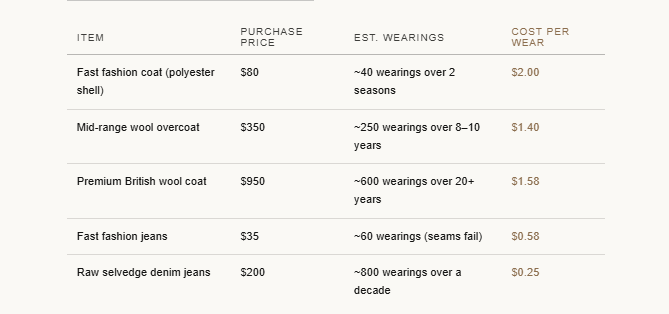
Notice something? That’s why it’s advisable to check and consider based on the quality not on the price. But that does not always good because fashion trend is also changing so fast. You have to keep this in mind too.
Certifications worth looking for
- GOTS (Global Organic Textile Standard): Covers both organic fiber and ethical processing, with audited labor standards. One of the most credible certifications in the industry.
- Fair Trade Certified: Focuses on labor standards and fair wages, independently audited. Not perfect but meaningful.
- B Corp certification: A broader business ethics certification; fashion brands holding it are generally more transparent about supply chains.
- Made in [country with strong labor law]: Garments made in Italy, Portugal, Japan, or similar countries carry an implicit labor standard guarantee, since domestic law is actually enforced.
- Supply chain transparency reports: The best brands publish named factory lists. If a brand can’t or won’t tell you where something was made, that’s information too.
When premium is just expensive branding
I want to be direct about this, because it’s important: not everything expensive deserves to be. The luxury fashion industry contains a significant amount of products that charge premium prices for heritage and cultural cachet rather than construction quality. And that’s a legitimate market but it’s a different transaction than what this guide is about.
A $600 logo t-shirt from a major streetwear brand may be made from the exact same fabric as a $25 t-shirt from a commodity retailer. The difference you’re paying for is the social signal of wearing that name, the community association it implies, and the artificial scarcity the brand creates. None of that is fabricated value, cultural meaning is real value to the people who care about it. But it’s not the same as paying for a higher quality garment.
Similarly, some heritage brands coast on reputation while quietly offshoring production and reducing specifications. A brand that made exceptional goods thirty years ago on a domestic supply chain may now produce comparable goods to mid-market brands at premium prices. Reputation and quality can decouple over time. Trust your hands and eyes over a label.
How to spot real quality in a store or online
You now have the context to evaluate a garment intelligently. Here’s a practical checklist for in-store evaluation and tips for buying quality online where you can’t touch the fabric.
In store: The five-minute quality check
- Turn it inside out first. Examine the seams: Are they neat, with finished edges (serged, bound, or flat-felled)? Or do they have raw, fraying edges? The interior of a garment is the one place a maker can’t hide corner-cutting.
- Rub the fabric between your fingers and hold it to the light. Premium natural fibers have a distinct warmth, weight, and opacity. Synthetics often look slightly shiny, feel lighter than they look, and have a plasticky quality when you rub them together.
- Check the buttons and buttonholes. Cross-stitched button shanks (the thread is wound around the thread base, lifting the button off the fabric) indicate care. A flat-sewn button will tear off quickly. Machine-made buttonholes have looped ends, hand-made ones are clean rectangles.
- Look at pattern alignment. If the garment has any stripe, check, or print; does it align perfectly at the side seams? Does the chest pocket (if any) match the body? Mismatch means bulk cutting and cost-saving.
- Check the lining. In outerwear or tailored pieces, the lining should be clean, well-attached, and not pulling or bunching. Cheap linings tear from stress points within a year; a well-attached lining reinforces the garment structure.
- Ask about the fabric content and origin. A salesperson who can tell you the mill name, fiber specification, or country of manufacture knows what they’re selling. Vague answers (“it’s a high-quality blend”) suggest they don’t, or can’t say.
Online: buying quality without touching it
Online quality purchasing is harder but not impossible. Look for fabric weight listed in GSM (grams per square meter), for shirts, 120–140 GSM is light/summer weight; 160–180 is substantial. For wool pieces, look for micron count. Read reviews that specifically mention durability after washing or wear, not just initial impressions. Buy from brands that offer free returns, and make a habit of doing the touch-test before the first wash so you can return if the fabric disappoints. Customer service responsiveness is also a signal, brands that make quality goods want to stand behind them.
The bottom line
Premium apparel is worth the price when – and only when the premium reflects something real, better raw materials that feel and age differently, skilled construction that will outlast multiple cheaper replacements, ethical production that doesn’t externalize costs onto vulnerable workers and the environment, and a cost-per-wear that works out in your favor over time.
It is not worth the price when you’re paying for a logo, a heritage narrative, or a marketing story attached to garments that wouldn’t pass a basic quality inspection. The skill you’re developing by reading this guide is the ability to tell those two things apart.
Buy less. Buy better. Take care of what you own. Wear it until it’s genuinely worn out and then, if it was truly quality, have it repaired. That’s the whole philosophy, and it’s both better for your wardrobe and for the world.
Frequently asked questions
Is expensive clothing always better quality?
No and this is one of the most important points in this entire guide. Price and quality correlate reasonably well up to a certain point, and then diverge significantly. At very high price points, you’re often paying for brand prestige, exclusivity, marketing costs, and retail margins rather than construction quality. A $1,500 luxury brand shirt is not necessarily better made than a $180 shirt from a quality independent brand. Do the physical inspection: fabric hand, seam finishing, construction details. Let the garment itself make the case, not the tag.
How can I find good quality clothing without spending a fortune?
A few reliable routes: (1) Quality secondhand. A well-made garment from a charity shop, eBay, or a platform like Vestiaire Collective at 20% of its original price is one of the best value propositions in fashion. Quality holds up, the original construction and fabric are still there. (2) End-of-season and sample sales from quality brands. (3) Factory seconds- Garments with minor cosmetic flaws sold directly by manufacturers at significant discounts. (4) Learning to sew basic repairs, which extends the life of everything you own. (5) Building your knowledge of quality signals so you can recognize them wherever they appear, including in less famous brands.
Does Cashmere always justify its price?
Not all cashmere is created equal, and cheap cashmere is often a disappointment. The dramatic expansion of cashmere production over the past two decades driven by fast fashion demand has led to shorter fibers, lower grades, and looser knit constructions to bring prices down. A $60 cashmere sweater will pill aggressively within weeks of wear. True quality cashmere tightly knit from long-staple fiber, typically from Scottish or Italian mills, starts around $250–300 for a sweater and lasts decades with good care. If you can’t afford genuine quality cashmere, a quality merino wool sweater at a fraction of the cost will actually outperform it on durability.
How do I care for quality garments to maximize their lifespan?
The principles are straightforward but require habit change for most people. Wash less frequently, most garments don’t need washing after every wear, airing them out is enough. When you do wash, use cold water and gentle cycles for everything except heavily soiled items. Lay knitwear flat to dry, never hang a wet sweater. Store woolens with cedar blocks to deter moths. Use a fabric comb (not a razor) for pilling on knitwear. Press shirts and trousers with a damp cloth between iron and fabric to prevent shining. Rotate shoes with shoe trees to preserve their shape. Have shoes resoled before the upper wears out. Learn basic hand stitching to repair small tears before they become large ones. These habits will double the lifespan of anything you own.
What about sustainable and ethical brands – are they worth the premium?
This depends on what you mean. Some brands charge a premium purely for ethical/sustainability positioning while the actual garments are mediocre quality you’re paying a conscience fee without getting a better product. The best sustainable brands are those where ethical production and quality construction reinforce each other- they pay skilled workers well because skilled workers make better things, they use quality materials because quality materials have lower true environmental cost when amortized over their lifespan. Look for brands where you can verify both the ethics claims and the construction quality independently. The goal is to buy things that are good to own and good to have made, not to buy things that are merely less bad.
We write rarely, but only the best content.
